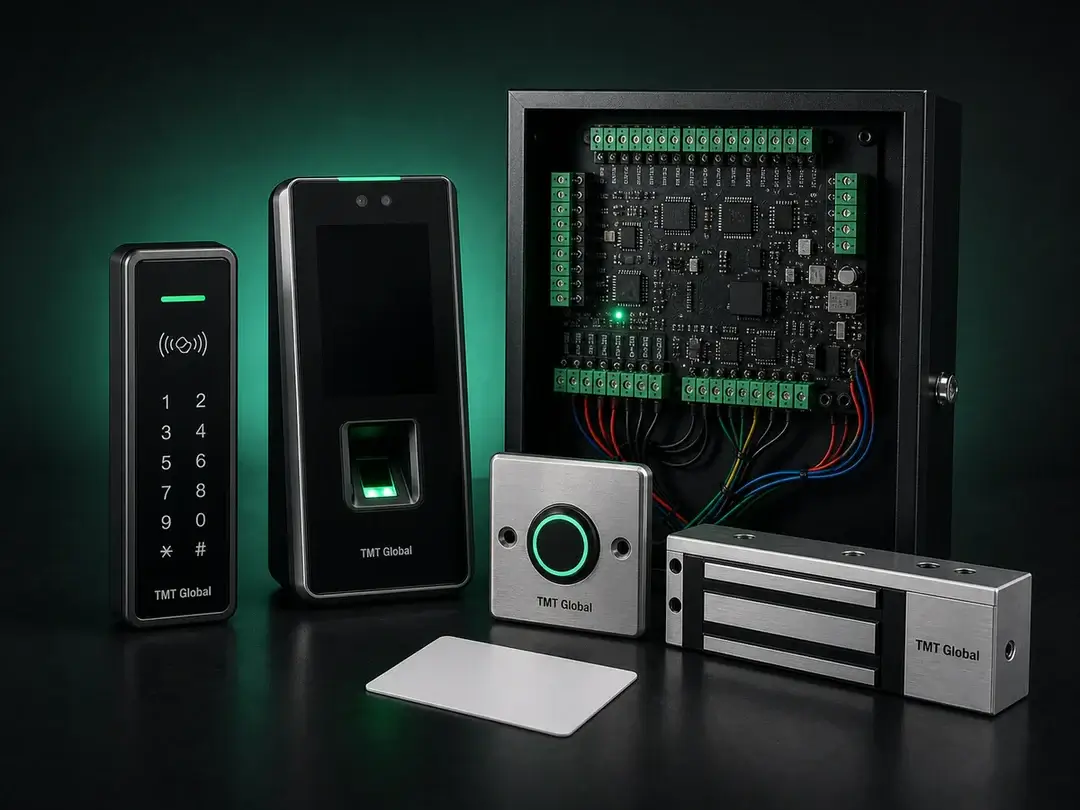

Access Control Systems
Coordinate controllers, readers, credentials, locking hardware and exit devices around the requirements of each controlled opening.
Design the complete controlled opening.
Reliable door control depends on compatible devices, a defined operating architecture and accurate project information - not isolated product selection.
Defined architecture
Start with door count, management method and the required controller arrangement.
Compatible devices
Coordinate readers, credentials, locks, exit devices, power and interfaces.
Project documentation
Use the exact model information and current technical documents during selection.
Application review
Confirm door construction, operating workflow and installation environment.
Build the system from coordinated product families.
Open a live WooCommerce category to review the currently available TMT Global products and model information.
Door Access Controllers
Control equipment for coordinated door-access configurations.
View category →
Standalone Controllers
Local door-control options for suitable independent access points.
View category →
Card Readers
Reader products for supported credential and controller interfaces.
View category →
UHF Long Range Readers
Reader options for defined vehicle and longer-range identification workflows.
View category →
Access Control Locks
Electronic locking products for compatible door and control requirements.
View category →
Exit Buttons
Exit-request devices for the specified door workflow and environment.
View category →
Cards & Credentials
Credential products to be matched with the selected reader technology.
View category →Choose the operating approach before the model.
The correct product family depends on how the opening will be managed, how credentials will be presented and how door hardware will operate.
Networked control
For projects requiring coordinated management across defined doors and controller connections.
Standalone control
For suitable independent openings where the access logic is managed locally.
Long-range identification
For defined vehicle or controlled-entry workflows requiring compatible UHF products.
Define the access point before product selection.
Record these project inputs first, then verify the exact model against its current product information and documentation.
Identify each controlled opening and the physical door arrangement.
Confirm the required card, PIN, supported biometric or UHF workflow.
Define whether access will be managed locally or through a networked system.
Coordinate the required lock, release device and door operating logic.
Review compatible connections, power arrangements and associated cabling.
Check model references, available technical documents and project requirements.
Product pathways for different access requirements.
Application type helps define the architecture, but final selection must follow the exact opening, operating workflow and project specification.
Offices and workplaces
Controlled staff, visitor and restricted-area access points.
Education and healthcare
Defined access zones with coordinated door and credential requirements.
Facilities and logistics
Controlled personnel, service and vehicle-entry workflows.
Distributed premises
Projects requiring a documented approach across multiple locations.
Confidence comes from the exact product detail.
Requirements can vary by model, system architecture and project market. Review available documentation before approval or installation.
Model verification
Confirm the product reference, compatible interfaces and intended use.
System compatibility
Check controllers, readers, credentials, locks and accessories as one system.
Project requirements
Verify current documentation against the specification and local project needs.
Find documents through one controlled library.
Product-category datasheets and catalogues are managed on the Downloads page so the latest available document remains easier to locate.
Product datasheets
Review available model and product-family technical documents.
System catalogues
Access the current catalogue library and related product resources.
Document request
Ask the team about documentation for a specific model or project.
Access control system guidance.
These answers provide a starting point. Confirm every final selection against the current product information and project specification.
What should be defined before choosing an access controller?
Start with door count, door type, credential method, management architecture, lock operation, required interfaces and project documentation.
What is the difference between standalone and networked access control?
Standalone products manage a suitable access point locally. Networked systems coordinate defined doors through connected control equipment and management requirements.
How should readers and credentials be selected?
Confirm the supported credential technology, reader interface, controller compatibility, environment and required user workflow.
Can locks and exit devices be selected separately?
They should be reviewed as part of the complete controlled opening, including door construction, operating logic, power, interfaces and release requirements.
Where are TMT Global access control datasheets available?
Available datasheets and catalogues are managed through the Downloads page. For a specific model, contact info@tmtglobal.co.uk.
Planning a controlled entrance or multi-door system?
Share the door schedule, credential workflow, required architecture, locking arrangement and relevant project documentation with the TMT Global team.
Continue through the connected infrastructure portfolio.
Review adjacent systems where access, entrance control, cabling and building operation need to be coordinated.
Gate Automation
Entrance-control products for defined vehicle and pedestrian access requirements.
Explore system →Network Connectivity
Connectivity products that support coordinated infrastructure deployment.
Explore system →Building Automation
Cable and control pathways for connected building systems.
Explore system →Fire & Life Safety
Specialist cable categories for defined alarm, safety and control applications.
Explore system →